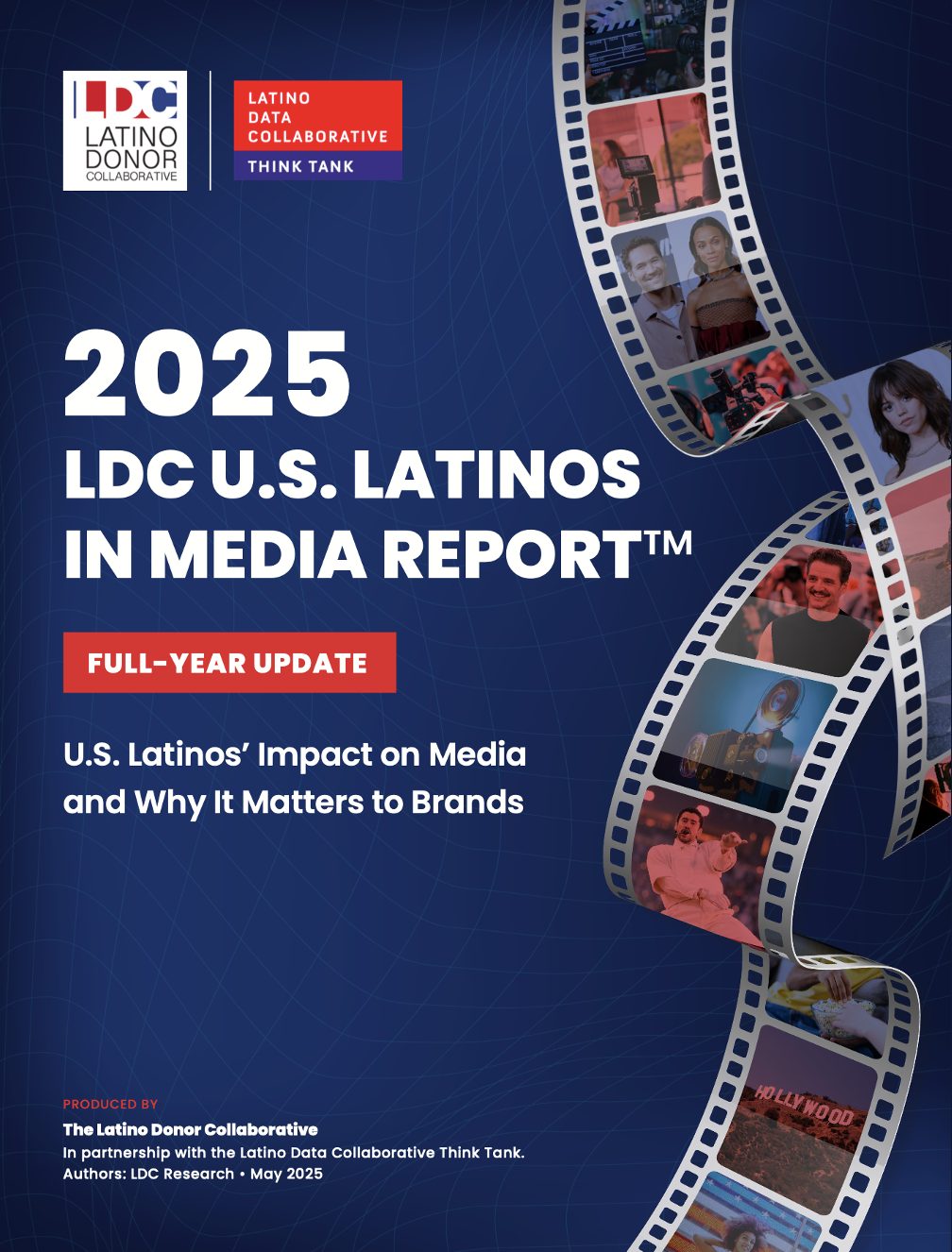
The 2025 LDC U.S. Latinos in Media Report™ Full-Year Update builds on nearly a decade of LDC research tracking Latino representation across film and television. This edition provides a business-driven analysis of how U.S. Latinos shape the modern media economy; and where strategy, capital, and creative authority are failing to keep pace with the audiences already sustaining the industry’s growth.
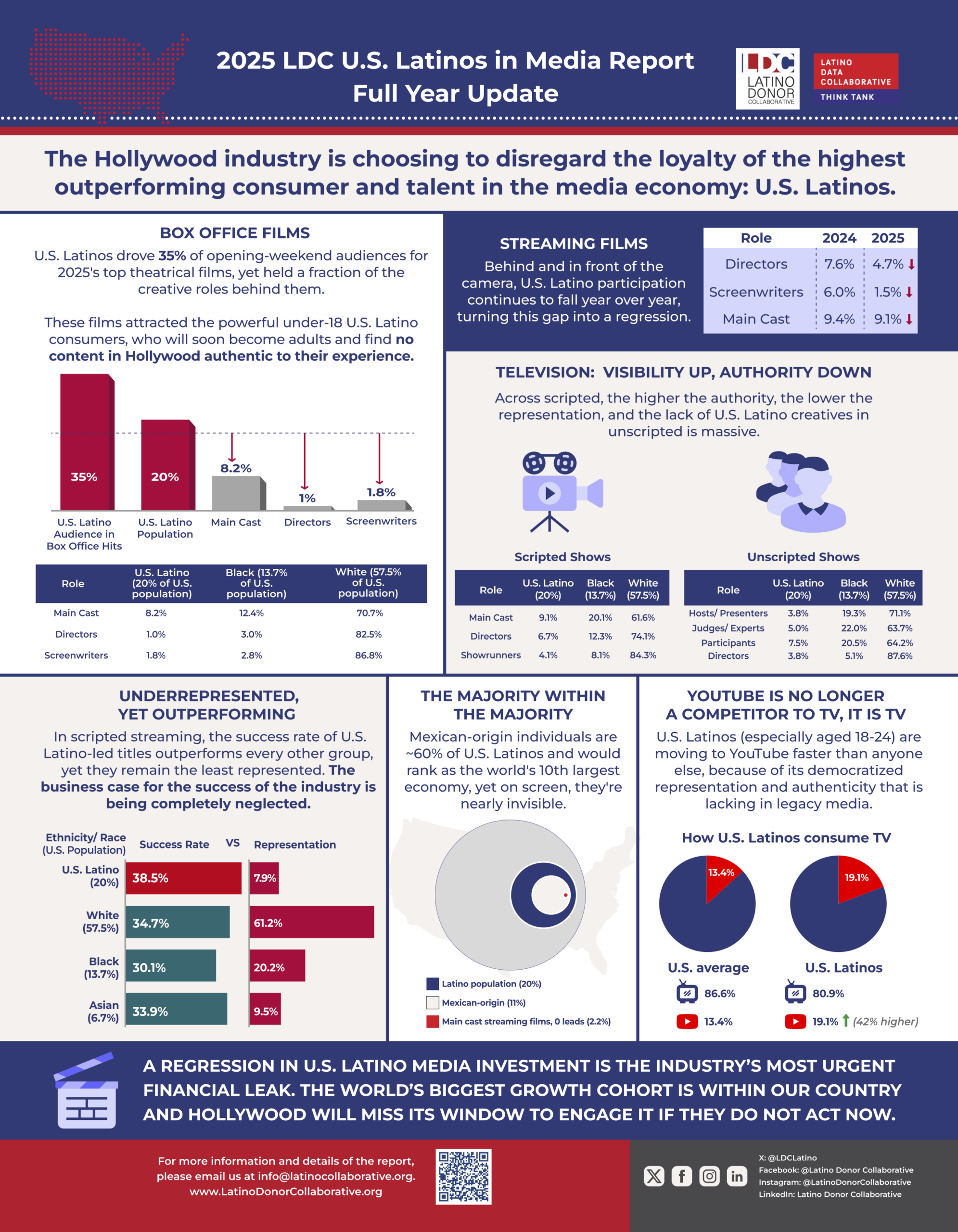
The findings are clear. U.S. Latinos over-index in theatrical attendance, engage deeply across streaming platforms, and remain a critical audience for ad-supported and live content. Yet across films and television, they continue to be the most underrepresented major demographic group, particularly in the roles that shape long-term value: leading roles, creative leadership, and decision-making behind the camera. The central conclusion of this report is that the industry’s greatest risk is not disruption, but misalignment; a gap between audience reality and what gets made, financed, and renewed.
Measured as a census rather than a sample, this report examines all qualifying English-language streaming films, box office films, and scripted and unscripted shows of 2025. It documents six structural signals defining the media economy: theatrical demand becoming concentrated rather than disappearing; YouTube solidifying its role as primary television; AVOD and FAST models becoming the profit core; live content anchoring ad-supported growth; unscripted programming expanding faster than representation; and advertisers emerging as the new gatekeepers. In every one of these shifts, U.S. Latinos are over-indexing in consumption while remaining underrepresented where long-term value is created.
This year’s update also introduces a focused new lens on Mexican-origin representation within Latino participation. Mexican-origin individuals make up roughly 60% of the U.S. Latino population and would rank as the world’s tenth-largest economy if measured independently; yet in many categories they remain even more underrepresented than aggregate Latino data suggests. The report’s message is one of precision: broad labels can obscure where misalignment is most severe, and understanding the majority within a growth audience is not a preference but a business necessity.
Throughout, the report pairs its data with case studies that demonstrate what is possible when Latino talent is included with intention and trust. These include a proof-of-performance analysis showing that Latino-led scripted streaming titles outperform every other group in success rate despite remaining the most underrepresented; an examination of how KPop Demon Hunters, co-written by Latina screenwriter Danya Jiménez, became one of Netflix’s biggest hits of 2025; an analysis of how cultural appropriation is eroding Hollywood’s future audience; and a look at how Zoe Saldaña became the highest-grossing actor of all time, proving that when Latino talent is treated as global talent, the box office responds.
The report does not frame representation as a matter of optics or intention. It examines it as a matter of market alignment, supported by tailored recommendations for studio executives, advertisers and brands, and audiences; from institutionalizing representation dashboards and moving beyond ensemble-only inclusion to following Latino audiences over legacy assumptions and signaling demand through viewing choices. It also includes a curated Latino Film & TV Watchlist to help audiences support the talent and projects shaping what comes next.
Whether you are a studio executive, advertiser, investor, creator, or audience member, the 2025 LDC U.S. Latinos in Media Report™ Full-Year Update is designed to be used as a tool, to inform decisions, measure progress, and align strategy with the audiences already driving the industry forward. Access the full report here and see how data-driven research can replace assumptions with facts and reveal the central role U.S. Latinos play in the future of media.