

U.S. Latinos are not just part of America’s economic future. They are powering it right now.
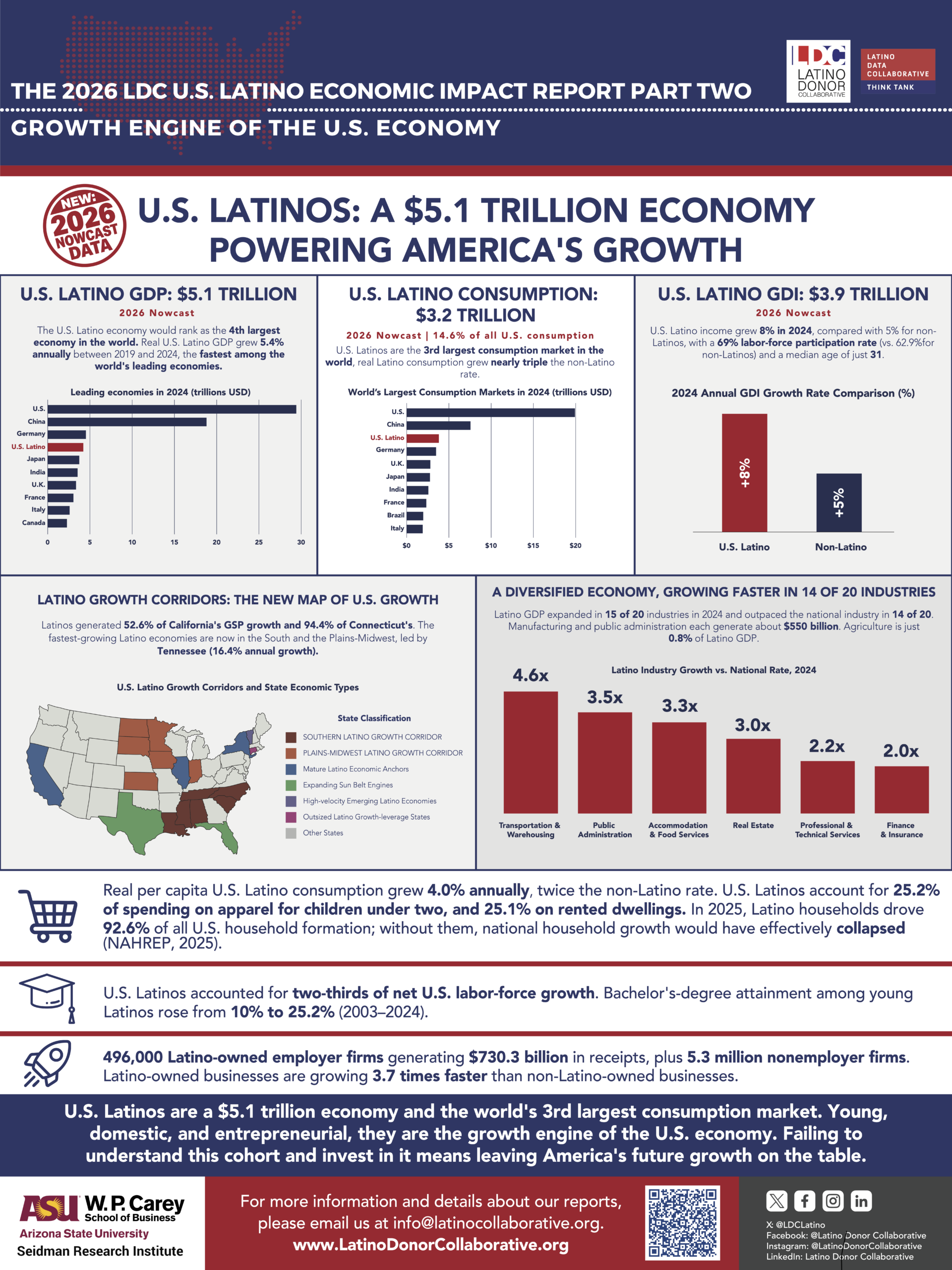
The 2026 LDC U.S. Latino Economic Impact Report – Part Two: Growth Engine of the U.S. Economy, produced with research partner the W. P. Carey School of Business at Arizona State University, introduces something new: for the first time, a nowcast of the U.S. Latino economy for the current year. The report estimates that the U.S. Latino economy reached $5.1 trillion in GDP in 2026, alongside $3.9 trillion in Gross Domestic Income. Measured as its own country, it would still rank as the fourth-largest economy in the world, ahead of Japan, India, the United Kingdom, France, Italy, and Canada. Between 2019 and 2024, it grew at an annualized 5.4%, faster than any of the world’s leading economies.
At the center of this growth is the U.S. Latino consumer. With an estimated $3.2 trillion in consumption in 2026, or 14.6% of all U.S. consumption, U.S. Latinos form the third-largest consumption market in the world, trailing only the United States and China. Between 2019 and 2024, real Latino consumption grew 6.5% a year. That is nearly triple the non-Latino rate and faster than China or India. This is not just population growth: real per capita Latino consumption grew twice as fast as non-Latino consumption, and Latino households with children grew five times faster. Latino families already account for more than a quarter of U.S. spending on children’s apparel and rented housing. That matters for every industry serving young households, from retail and housing to banking and consumer brands.
The report goes beyond the topline numbers with a state-by-state, industry-by-industry, and workforce analysis:
- States: In 2026, Latino economies are estimated at $1.23 trillion in California, $940 billion in Texas, $499 billion in Florida, and $399 billion in New York. The report also identifies new Latino Growth Corridors across the South and the Plains-Midwest, led by Tennessee, where the Latino economy grew 16.4% a year.
- Industries: In 2024, Latino GDP grew faster than the national industry in 14 of 20 industries. Growth was especially strong in transportation, finance, real estate, and professional services, while agriculture accounts for less than 1% of the Latino economy.
- Workforce and business: Latinos, a population of about 70 million, roughly 80% of them U.S. citizens, accounted for about two-thirds of net U.S. labor-force growth, mostly through U.S. births. Bachelor’s degree attainment among young Latinos has more than doubled. Latino-owned businesses grew 3.7 times faster than non-Latino-owned businesses between 2018 and 2023.
For CEOs, investors, policymakers, marketers, and anyone planning for what comes next, the conclusion is clear: the U.S. Latino economy is not a niche market or a future opportunity. It is one of the principal forces sustaining American growth today. Download the full report here to see where, and how, that growth is happening.